 Porto Wine Tours
Vila Nova de Gaia: The City Across the River from Porto
Vila Nova de Gaia is the city on the south bank of the Douro, directly facing Porto. It has been the official storage site for port exporters' wine since 1777, and more than 60 port cellars line the river. This guide covers what Gaia is, how to get there from Porto on foot, by metro or on the Gaia Cable Car, and how the riverside lodges line up. For the cellars visited one by one, see the guide to port wine cellars Porto, and for tour choices the comparison of Porto wine tours has the full table.
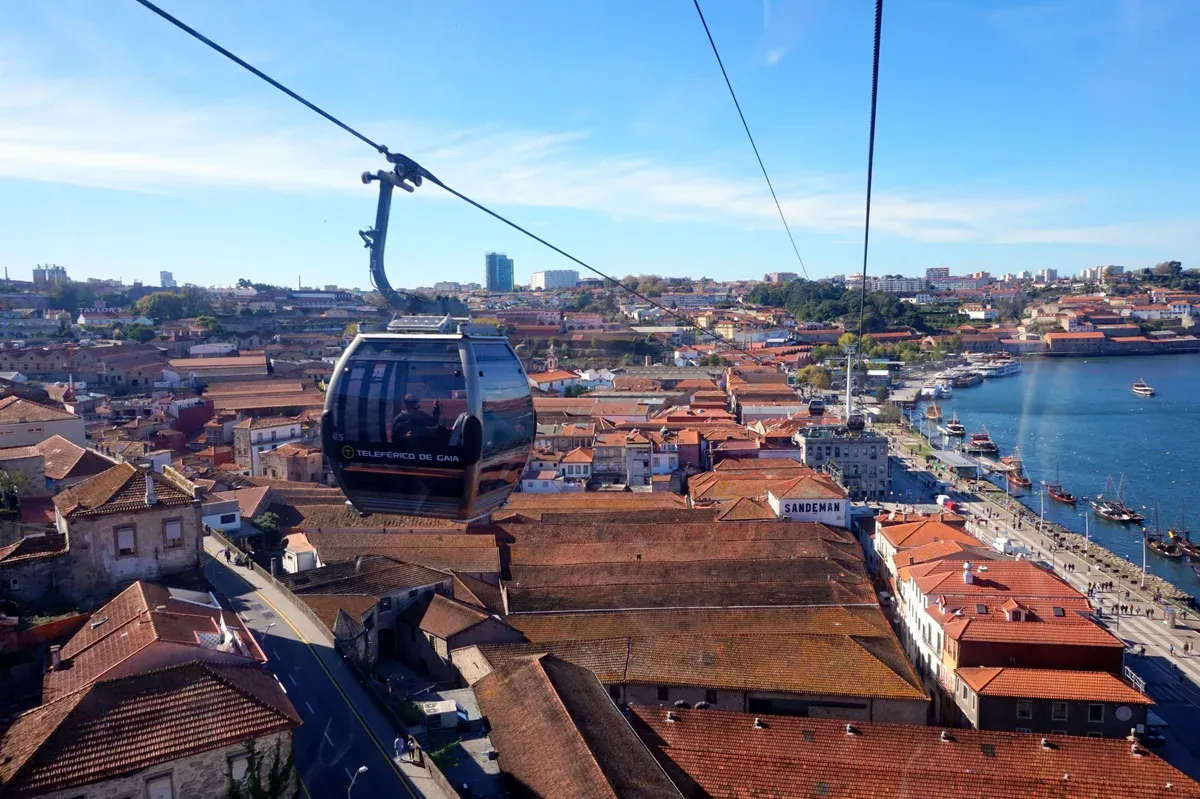
A Teleférico de Gaia cabin above the Gaia riverfront. Photo: Matt Kieffer from London, United Kingdom, CC BY-SA 2.0, via Wikimedia Commons
Quick answer Gaia in a nutshell
Vila Nova de Gaia is the city on the south bank of the Douro, and the Gaia Cable Car one-way fare is €7 per adult. You can also walk across the lower deck of the Dom Luís I Bridge from the Ribeira for free. Gaia holds the port lodges, the Cais de Gaia riverfront, the Jardim do Morro sunset garden and the WOW district.
Key takeaways
- Cross on foot over the Dom Luís I Bridge lower deck to reach the Cais de Gaia quay, or take Metro Line D one stop from São Bento to Jardim do Morro.
- The Teleférico de Gaia links the riverside to the hill top in 3 min 45 s for €7 one way.
- Most of the lodges sit in a walkable strip along the river, though Graham's, Poças and Real Companhia Velha are further out. The guide to port wine cellars Porto compares them one by one.
- Short on time? The Port Wine Lodges Tour with 7 tastings covers three houses on foot in about 4 hours for $64.14.
Vila Nova de Gaia in Short
Gaia is not a district of Porto. It is a separate city, with its own council, on the south side of the Douro.
A City, Not a Suburb
Vila Nova de Gaia had 303,824 inhabitants at the 2021 census, which makes it the third most populous municipality in Portugal. It covers 168.46 square kilometres and has been divided into 15 civil parishes since the 2013 reform. It was raised to city status only in 1984. People do call it part of greater Porto, and the two cities face each other across a river narrow enough to cross on foot, but it answers to its own council.
The municipality also has a long coast: 17 km of shoreline with 17 Blue Flag beaches, and the Gaia Biological Park covers 35 hectares away from the river. Most visitors never leave the riverside strip, and this guide stays there too.
Why Port Ages Here
Port wine is made in the Douro Valley, and for centuries rabelo boats carried the casks downriver to Gaia. Since 1777 Gaia has been the official storage site for the port exporters' wine, and the cellars are still called 'caves' locally, or lodges in English.
The trade shaped the city. A royal charter from King Afonso III in 1255 promoted the settlement as a harbour for cargo entering the Douro, and in 1288 King Denis and Queen Elizabeth renamed the lower settlement Vila Nova de Rey to concentrate the wine trade there. The Romans had called the south bank settlement Cale, and the area has been inhabited for at least 100,000 years. Today more than 60 port cellars line the Douro in Gaia, a count from secondary sources since no official figure exists.
The Cais de Gaia
The Cais de Gaia is the riverside promenade on Avenida de Diogo Leite, facing Porto's Ribeira across the water. It is where the lodge doors open onto the quay, where the rabelo boats are moored, and where the Gaia-side river cruises depart, with the pier listed at Av. de Diogo Leite 8. The port wine river cruise with 4 tastings leaves from the Gaia side and runs 2 hours on the water.
If you want the walking-tour version of the same strip, the small-group port and Douro wine tour with 9 tastings meets right on the riverfront at the Gaia tourism office, Avenida Diogo Leite 135, and visits three lodges in 3 hours. From the quay, the Teleférico de Gaia climbs the hill and the Dom Luís I Bridge fills the view upstream.
Sources: IVDP, Port wine categories, Gaia Cable Car prices and timetable
Getting to Gaia from Porto
Four ways cross the Douro to Gaia.
How the Listings Compare
Costs come from the Metro do Porto fare table and the cable car operator's own price page.
| Way | Cost | Time | Best for |
|---|---|---|---|
| Lower deck of the Dom Luís I on foot | Free | A short walk from the Ribeira to the Cais de Gaia | Going straight to the lodges on the quay |
| Upper deck of the Dom Luís I on foot | Free | Walk from the Ribeira up to Jardim do Morro | The view and the sunset garden |
| Metro Line D | Z2 single €1.40 on the Metro do Porto fare table, plus €0.60 card | One stop across the bridge | Starting from central Porto away from the river |
| Gaia Cable Car | Adult one-way €7, round trip €10 | 3 min 45 s per ride | Saving the climb from the quay to the hill |
Comparing the Four Ways
The table below compares the ways to reach the Gaia side from central Porto, with costs from Metro do Porto and the cable car operator's own price pages. The walk across the lower deck of the Dom Luís I Bridge costs nothing and drops you straight onto the Cais de Gaia. The upper deck takes you to Jardim do Morro instead, one level above the lodges.
Metro Line D crosses that same upper deck, and the cable car covers the last climb from the quay to the hill.
The Gaia Cable Car in Detail
The Teleférico de Gaia runs between two stations only: Jardim do Morro at the top and Cais de Gaia at the riverside. The operator lists the address as Calçada da Serra 143, Vila Nova de Gaia. A ride takes 3 min 45 s, and Andante metro tickets are not valid on it, so you buy separately.
Fares from the operator: adult one-way €7, child aged 5 to 12 one-way €3.50. Round trip is €10 for adults and €5 for children. A family ticket for 2 adults and 2 children round trip costs €22.50. Tickets stay valid for 30 days, VAT included.
Hours follow the seasons. From late March to late April and from late September to late October the cars run 10:00 to 19:00 daily. In high season, late April to late September, hours stretch to 10:00 to 20:00. The rest of the year, late October to late March, they run 10:00 to 18:00. The only closing day of the year is Christmas Day.
Metro Line D
Line D is the fastest option if you start away from the river. It crosses the upper deck of the Dom Luís I Bridge, and the Gaia-side stations are Jardim do Morro, which opened in 2005 with step-free access, and General Torres one stop south. Trains run about every 5 to 6 minutes on weekdays and every 10 minutes on weekends and evenings.
The Metro do Porto fare table lists a Z2 single occasional ticket at €1.40 and a 10-pack at €14, and fares may change in 2026, loaded onto an Andante Azul card that itself costs €0.60 and works on the metro, STCP buses and CP suburban trains. Note that the metro fare does not cover the cable car, which sells its own tickets at the figures above.
Porto's Cable Car, Teleférico de Gaia
The cable car ride between Jardim do Morro and the riverside in Gaia. Third-party video by Travel Everywhere. This site did not shoot it and has no relationship with the creator.
The Riverfront and the Lodges
Most of the port lodges sit in a strip along the Douro, with a few further out.
How the Lodges Line Up
Walk off the lower deck of the bridge and the big names start close to the quay. Cálem sits close to the river with its interactive museum, Sandeman is a short block inland at Largo Miguel Bombarda, and the other lodges continue along and behind Avenida de Diogo Leite. Ramos Pinto sits further west along the avenue, Poças lies inland, and Real Companhia Velha is further east in Oliveira do Douro. Taylor's stands at Rua do Choupelo 250, on the same street as WOW, the World of Wine district, at number 39. Graham's is further west, with its reception at Rua do Agro 141.
Each lodge sells its own visits and tastings, with different prices, durations and pours. The guide to port wine cellars Porto has the lodge-by-lodge visits and booking notes. If you would rather a guide handle the choices, the tours below cover the strip on foot.
Two Ways to Tour the Strip
The Port Wine Lodges Tour with 7 tastings is a 3.5-4 hour guided walk through three port houses for $64.14, with lodge entry tickets included, a small group and a tasting lesson at the end. It meets on the Porto side by the lower level of the Dom Luís I Bridge and crosses into Gaia on foot. Note that lunch, hotel pickup and snacks are not included.
The Taylor's Port Cellars and Tasting is the single-lodge option, $28 for a self-guided audio tour of the Taylor's cellars plus 3 ports, meeting at the lodge door on Rua do Choupelo 250. More single-lodge tickets, from Cálem to Graham's to Poças, are compared on the cellars page, and the WOW district gets its own guide at WOW Porto.
The Rabelo Boats on the Quay
The flat-bottomed wooden boats moored along the Cais de Gaia are rabelos, the cargo boats of the Douro, found nowhere else in the world. They carried port casks from the valley down to Gaia, loads of 40 to 100 pipes with crews of up to 12, and the name means 'little tail' after the long steering oar at the stern. A law of 1779 capped loads at 70 casks, the Douro railway of 1887 ended their monopoly, and dams built from 1968 onwards closed the old rapids for good.
Today the port houses own them as floating advertising along the quay, while the tourist boats are rabelo replicas. Every 24 June, the São João holiday, a rabelo regatta races on the Douro, organised by the Port Wine Brotherhood. For what sails today, the guide to Porto boat tours covers the river options.
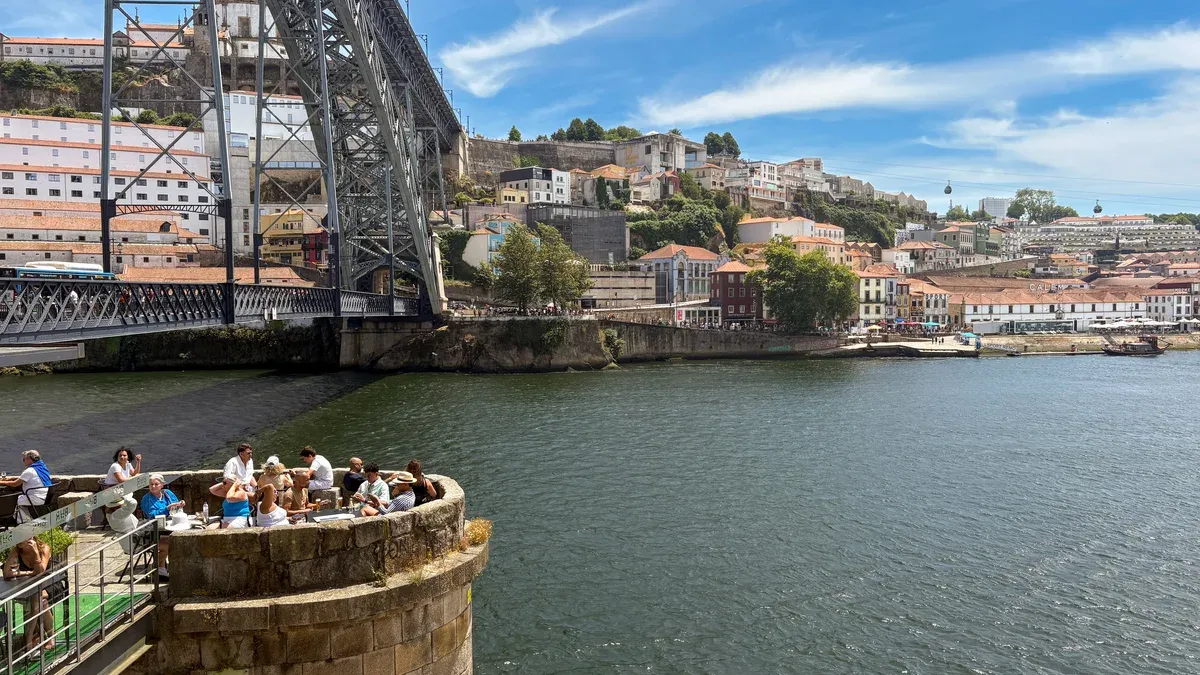
The Douro riverbank below the Dom Luís I bridge with the Gaia side and its port cellars across the water. Photo: Dale Cruse - 10M views from San Francisco, CA, USA, CC BY 4.0, via Wikimedia Commons
Serra do Pilar and Jardim do Morro
The hill at the Gaia end of the bridge holds a UNESCO-listed monastery, a free viewing terrace and a popular sunset garden.
The Monastery of Serra do Pilar
The monastery was founded in 1537 by the Canons Regular of St Augustine, and Wikipedia dates the start of construction to 1538. Its circular church and circular cloister have the same diameter, which makes it one of only two circular monastic churches in Portugal. The circular church was inaugurated on 17 July 1672. It stands 36 m tall and the bell tower 20 m, in Renaissance and Mannerist style with Baroque elements. The site is a piece of military history too. The Duke of Wellington used it in 1809 to launch his surprise crossing of the Douro against the French, and during the Siege of Porto (1832-33) it was the only Liberal stronghold on the south bank.
Portugal declared it a National Monument on 16 June 1910. UNESCO inscribed it in 1996 as part of the 'Historic Centre of Oporto, Luiz I Bridge and Monastery of Serra do Pilar' site, under criterion (iv). A military barracks still occupies part of the grounds, installed in 1947, and the church holds Sunday Mass.
| Serra do Pilar visit | Detail |
|---|---|
| Address | Largo de Aviz, 4430-329 Vila Nova de Gaia |
| Cloister and dome visit | €2 |
| Outside terrace viewpoint | Free |
| Hours | Tue-Sun 10:00-18:30 summer, 10:00-17:30 winter |
| Closed | Mondays |
| Access | Metro Line D to Jardim do Morro, or the Gaia cable car upper station |
Jardim do Morro at Sunset
Jardim do Morro is a free public garden just south of the upper deck of the Dom Luís I Bridge. It was laid out in 1927 and is open around the clock. The lawn slopes towards the river, so you get Porto's Ribeira, the bridge arch and the Douro in one frame. It is a popular sunset spot on the Gaia side. The garden sits right next to the monastery and the cable car upper station, so the three combine easily.
The metro station of the same name opened on 17 September 2005 on Avenida da República, with step-free access and 2 side platforms. Line D trains run about every 5-6 minutes on weekdays and every 10 minutes on weekends and evenings. For more on the bridge itself, see the Ponte Luís I guide.
Rabelos and Boats from Gaia
The boats moored on the Gaia quay are working history, and the six bridges cruise is the easiest way onto the water.
The Rabelo Boats on the Quay
The rabelo is a flat-bottomed wooden cargo boat of the Douro, found nowhere else in the world. It carried Port wine casks from the valley down to the lodges in Gaia. The name means 'little tail', after the long timber steering oar at the stern, worked from a raised platform. Full-size rabelos ran 19-23 m long, carried 40-100 pipes of Port with a crew of up to 12, and in 1779 legislation capped loads at 70 casks. Clearing the Cachão da Valeira gorge began in 1780, with the first vessels through in 1789 and the work finished in 1791.
The Douro railway was completed in 1887 and ended the rabelo's monopoly on wine transport. Dams built from 1968 onwards ended navigation of the old rapids. Sources disagree on the last commercial voyage: Taylor's-style accounts give 1964, the Cruzeiros Douro blog gives 1971. Today Port houses own the moored boats as floating advertising, and every 24 June a rabelo regatta runs on the Douro for São João, organised by the Port Wine Brotherhood.
Six Bridges Cruises from the Gaia Side
The six bridges are Dom Luís I, Arrábida, Infante D. Henrique, Maria Pia, São João and Freixo. Cruises board at either Cais da Ribeira on the Porto side or the Gaia quay at Av. de Diogo Leite, on rabelo replicas with modern navigation gear. Cruzeiros Douro boards on the Gaia side and Tomaz do Douro at Cais da Ribeira.
The table compares them, and the full rundown of options is on the Porto boat tour page.
| Operator | Duration | Price | Departures | Notes |
|---|---|---|---|---|
| Cruzeiros Douro | 50 min | €18 from Gaia pier, €20 from Ribeira pier | Every 30 min, 10:00-18:00 April-September, 10:00-16:00 October-March | Free up to age 3, 50% off ages 4-12, 10% off online, guides in Portuguese, English, Spanish and French |
| Tomaz do Douro | 50 min | €18 adult | Fri-Sun 10:00-18:30, subject to change | Children 4-12 50% off, Porto.CARD holders 20% off when booking direct, sails upstream to Freixo then to the Douro mouth |
Wine on the Water Instead
If you want the wine in the glass rather than in the story, two bookable options combine a cruise with tastings. The 7 Bridges Port Wine River Cruise with 4 Tastings is a 2-hour shared boat from the Gaia side at $62 with 4 port wines and no cellar visits. The Luxury Yacht Cruise with Wine Tasting and Snacks is a 2-hour yacht for up to 12 at $62.99, passing under the 6 bridges and out to where the Douro meets the sea, though the pour is Vinho Verde, not Port. For the lodges themselves, one line each and the full list live in the port wine cellars Porto guide.
An Afternoon in Gaia
A downhill route from the hill to the river that links the viewpoint, the gardens, the cable car, the lodges and the bridge.
The Route in Eight Steps
The logic is simple: start high, end low, and never climb twice. Figures come from the operator and museum pages cited through this guide.
Step by Step
- Take Metro Line D one stop from São Bento to Jardim do Morro. A Z2 single is listed at €1.40, plus a €0.60 Andante card if you do not have one, and trains run every 5-6 minutes on weekdays.
- Walk into Jardim do Morro and claim a patch of grass. It is free, open around the clock, and faces the bridge and the Ribeira.
- Visit the Serra do Pilar monastery next door. The cloister and dome cost €2, the outside terrace is free, and it is open Tuesday to Sunday 10:00-18:30 in summer and 10:00-17:30 in winter, closed Mondays.
- Ride the Gaia Cable Car down from the Jardim do Morro station. A one-way adult ticket is €7 and the ride takes 3 min 45 s. Keep the ticket if you might ride back, as round trip €10 is valid 30 days.
- Step off at Cais de Gaia and walk the riverside promenade along Av. de Diogo Leite past the moored rabelos.
- Pick a lodge. A single-house visit such as Cálem starts at $25 for about an hour with a tasting, and the self-guided Taylor's visit costs $28. See the port wine cellars Porto guide for the full list with each lodge's visit details.
- If time allows, go to WOW at Rua do Choupelo 39. Main museums open daily 10:00-19:00, with last entry at 18:00 for the Port and Wine Experience, and each experience takes about 1h30. The details are on the WOW Porto page.
- Finish on foot. Cross back to Porto on the lower deck of the Dom Luís I Bridge, which carries pedestrians alongside buses and cars, and look up at the iron arch with its 172.5 m main span as you go.
Gaia Tips
Five habits that make the day smoother, and four mistakes that cost money or time.
Do
- Do buy a round trip cable car ticket at €10 if you plan to ride both ways, because it is valid 30 days and cheaper than two singles at €7 each.
- Do keep your €2 Serra do Pilar ticket time in mind, since the monastery closes at 18:30 in summer and 17:30 in winter and shuts completely on Mondays.
- Do start the six bridges cruise from the Gaia pier, because Cruzeiros Douro charges €18 there against €20 at Ribeira.
- Do get an Andante Azul card for €0.60, rechargeable for a year, because Line D crosses the upper deck between the two banks.
- Do watch the clock on lodge visits, since the Port and Douro wine tour meets at 14:30 at the Gaia tourism office.
Don't
- Don't assume the cable car takes Andante tickets, because the operator states they are not valid and fares are paid separately.
- Don't plan on driving to the riverfront, because Line D runs about every 5-6 minutes on weekdays.
- Don't book a wine cruise expecting Port and a cellar, because the yacht cruise at $62.99 pours Vinho Verde and the river cruise at $62 has no cellar visits.
- Don't trust a WOW price quoted by a reseller without checking wow.pt first.
Where to Stay Near the Port Lodges
Each link opens the live room list for that area. The Gaia riverside puts the lodges on your doorstep, Ribeira is across the lower deck of the bridge, and the hill by Jardim do Morro sits at the top of the cable car.
Cais de Gaia
- Suits
- The lodges, the riverside restaurants and the boats
The riverside lodges are a short walk along the quay.
See stays in Cais de Gaia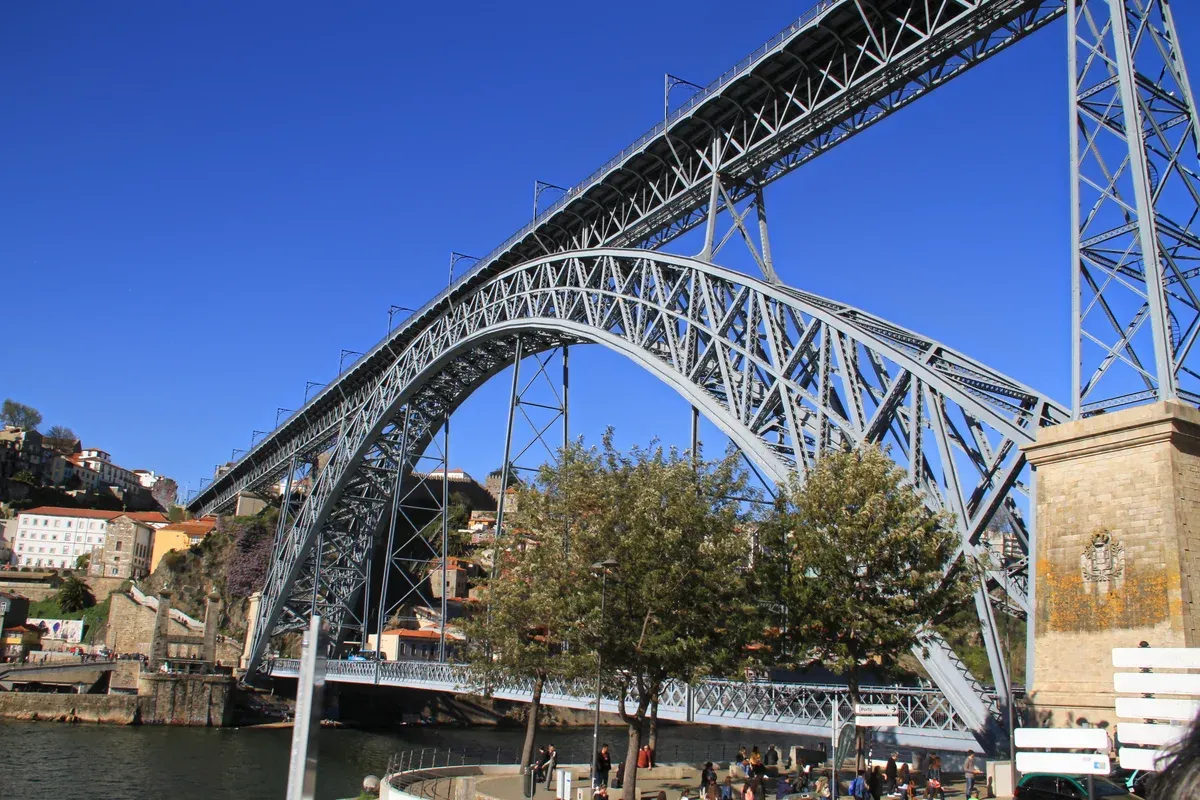
Ribeira
- Suits
- The old town on the Porto side, a walk across the lower deck to the lodges
The lower deck of the Ponte Luís I links Ribeira with the Gaia quay on foot.
See stays in RibeiraJardim do Morro
- Suits
- The upper deck, metro line D and the cable car down to the river
The Gaia Cable Car runs from here to Cais de Gaia for €7 one way.
See stays in Jardim do MorroVila Nova de Gaia Questions
Where is Vila Nova de Gaia?
It is the city on the south bank of the Douro, directly facing Porto across the river. The Dom Luís I Bridge links the two, with Metro Line D on the upper deck, and the port lodge district sits right on the Gaia waterfront. The full orientation is in the Vila Nova de Gaia guide.
How far is Vila Nova de Gaia from Porto?
The riverside districts face each other directly across the Douro. Metro Line D crosses the upper deck of the Dom Luís I Bridge with trains about every 5-6 minutes on weekdays.
What is there to do in Vila Nova de Gaia?
The core is the port lodge district, the Cais de Gaia promenade, the Serra do Pilar monastery with its €2 dome visit, Jardim do Morro at sunset and the cable car between them. Add the six bridges cruise at €18 from the Gaia pier. The full list is in this guide, and the lodges walking tour with 7 tastings covers three houses in one booking.
How much does the Gaia cable car cost?
The operator lists a one-way adult ticket at €7 and a child aged 5-12 at €3.50. Round trip is €10 for adults and €5 for children, and a family ticket for 2 adults plus 2 children is €22.50. The ride takes 3 min 45 s and Andante tickets are not accepted.
Is the Serra do Pilar viewpoint free?
Yes, the outside terrace viewpoint is free. The paid part is the €2 visit to the circular cloister and the church dome, open Tuesday to Sunday 10:00-18:30 in summer and 10:00-17:30 in winter and closed on Mondays.
Can you walk from Porto to Vila Nova de Gaia?
Yes. You can cross the Dom Luís I Bridge on foot on either deck: the upper deck with Metro Line D and pedestrians, or the lower deck with road traffic and pedestrians. The upper deck drops you at Jardim do Morro, the lower deck at Cais de Gaia. The bridge's own page has the details.