 Porto Wine Tours
Ponte Luís I
The Ponte Luís I is the double-deck iron bridge that carries you from Porto's Ribeira across the Douro to Vila Nova de Gaia, where the port wine lodges line the river. This guide covers the bridge itself, the difference between the two decks, and the walk to Cais de Gaia and on to Taylor's and Graham's. It also flags the guided port wine tours in Porto that start or finish at the bridge, so you can turn a simple crossing into a tasting afternoon.
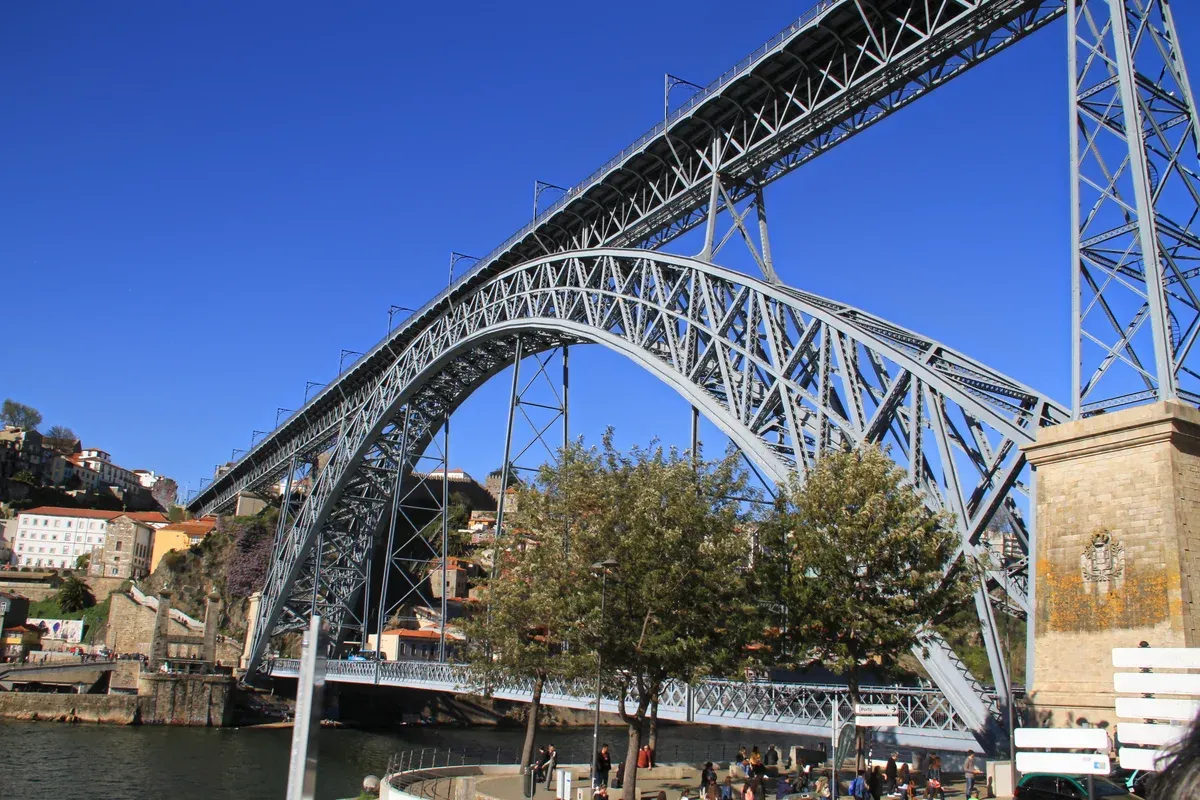
Low-angle view of the iron arch of the Dom Luís I bridge in Porto. Photo: ThomasLendt, CC BY-SA 4.0, via Wikimedia Commons
Quick answer The bridge at a glance
The Ponte Luís I was built between 1881 and 1886 to a design by Théophile Seyrig, with an iron arch whose 172.5 m main span was the longest of its type in the world when it opened. The upper deck carries Metro Line D and pedestrians, the lower deck carries road traffic and pedestrians. Walking across is free, and both decks land you in Vila Nova de Gaia, home of the port lodges.
Key takeaways
- Upper deck for the view and the metro, lower deck for the riverside: see Upper Deck or Lower Deck.
- The bridge is the main walking route from Ribeira to the port lodges: read Crossing to the Port Lodges.
- The Port Wine Lodges Walking Tour meets by the pillars of the old Pensil bridge at the lower deck on the Porto side and costs $64.14.
- Planning a tasting day on the far bank? Start with Vila Nova de Gaia.
The Bridge in Numbers
Every figure below comes from the standard published record of the bridge. The table gathers them in one place before the section on who built it.
Key Figures
The Ponte Luís I is a double-deck iron arch bridge over the Douro between Porto and Vila Nova de Gaia. The figures in the table come from the published record of the bridge. Together they explain why the bridge still dominates the riverfront more than a century after it opened.
The span was the longest of its type in the world at the time, and the deck height of about 70 m is what gives the upper walkway its view over the Ribeira roofs.
| Fact | Figure | Source |
|---|---|---|
| Construction period | 21 November 1881 to 30 October 1886 | Wikipedia, Dom Luís I Bridge |
| Inauguration | 31 October 1886 | Wikipedia, Dom Luís I Bridge |
| Designer | Théophile Seyrig | Wikipedia, Dom Luís I Bridge |
| Builder | Société de Willebroek (Belgian) | Wikipedia, Dom Luís I Bridge |
| Main arch span | 172.5 m, longest of its type in the world when built | Wikipedia, Dom Luís I Bridge |
| Upper deck length | 395.25 m | Wikipedia, Dom Luís I Bridge |
| Lower deck length | 172 m | Wikipedia, Dom Luís I Bridge |
| Height | about 70 m | Wikipedia, Dom Luís I Bridge |
| Construction cost | 369,000$00 réis | Wikipedia, Dom Luís I Bridge |
| Toll period | 1 November 1886 to 1 January 1944 | Wikipedia, Dom Luís I Bridge |
| National Monument | 26 February 1982 | Wikipedia, Dom Luís I Bridge |
| UNESCO listing | 1996, with the Historic Centre of Oporto and the Monastery of Serra do Pilar | UNESCO World Heritage Centre |
Seyrig, Eiffel and the Longest Arch of Its Day
Théophile Seyrig was a partner of Gustave Eiffel, and the two had already worked together in Porto on the nearby D. Maria Pia railway bridge. The structure was built by the Belgian Société de Willebroek. The 172.5 m arch was the longest of its type anywhere when it opened.
Gustave Eiffel is frequently credited with the bridge, but the record credits the design to Seyrig alone. The Eiffel association belongs to the D. Maria Pia bridge. The bridge earned its keep from day one: a toll was charged from 1886 until 1944, and today the crossing is free on foot.
Road traffic left the upper deck in 2003 when it closed for conversion to Metro Line D, and the Infante D. Henrique bridge downstream took the vehicles. The bridge now shares UNESCO listing with the historic centre of Porto and the Monastery of Serra do Pilar on the Gaia side, inscribed in 1996.
Sources: Wikipedia, Dom Luís I Bridge, UNESCO World Heritage Centre
Upper Deck or Lower Deck
Both decks are open to pedestrians and both are free. The difference is what you stand next to, how high you are, and where you land.
The Upper Deck: Metro, Wind and the Big View
The upper deck is 395.25 m long and carries Metro Line D and pedestrians. Trains run about every 5-6 minutes on weekdays and every 10 minutes on weekends and evenings, so you will share the deck with them. The Metro do Porto fare table lists a Z2 single at €1.40 if you ride rather than walk.
The Gaia end of the deck lands directly at Jardim do Morro metro station, next to the Jardim do Morro garden and the Serra do Pilar monastery, and beside the upper station of the Gaia cable car. This is the deck for the wide view: at about 70 m above the river you look down on the rabelo boats, the Ribeira fronts and the whole of the Gaia lodge quarter. Jardim do Morro is open around the clock and is the popular sunset spot on the Gaia side.
The ride to the top of the bridge is also the answer to how you get to the top of the Dom Luís bridge if you would rather not climb from the Ribeira: take Line D one stop from São Bento, using an Andante Azul card, which costs €0.60.
The Lower Deck: Road Traffic and the Riverside Landing
The lower deck is 172 m long and sits just above the water. It carries road traffic, buses and taxis, and pedestrians. Cars are close, so it is noisier and less scenic than the top deck, but it has one big advantage: the Gaia end lands you straight onto the Cais de Gaia, the riverside promenade where the first port lodges and the rabelo boats are.
If your goal is a cellar visit or a river cruise, use the lower deck. Walking from Ribeira to Gaia means crossing the lower deck on foot to the Cais de Gaia, or the upper deck to Jardim do Morro, so allow a relaxed pace. The Porto end of the lower deck is also where the Port Wine Lodges Walking Tour meets, by the pillars of the old Pensil bridge, before crossing into Gaia with its 7 tastings across 3 port houses.
Which Deck When
Cross on the upper deck when the view is the point: first arrival, sunset, or photos from the Serra do Pilar terrace, which is free, while the monastery cloister and dome visit itself costs €2 and opens 10:00-18:30 in summer and 10:00-17:30 in winter, closed Mondays. Cross on the lower deck when a lodge, a cruise or a Gaia restaurant is the destination, because it drops you at river level with no climb. One option is to walk over on top for the view, take the Gaia cable car down, and walk back on the bottom.
If you would rather have someone handle the route, the Small-Group Port and Douro Wine Tour with 9 Tastings starts on the Gaia riverfront itself at the tourism office on Avenida Diogo Leite, so you cross the bridge once and then walk between 3 lodges with 9 pours in 3 hours.
Dom Luís I Bridge Crossing on Foot
A walk across the bridge from the Porto side, with the river and the lodges below. Third-party video by World Walks 4K. This site did not shoot it and has no relationship with the creator.
Crossing to the Port Lodges
The bridge is not just a viewpoint. It is a main walking route to the port wine cellars of Vila Nova de Gaia.
Ribeira to the Riverside Lodges
From the Ribeira waterfront in Porto, take the lower deck of the Ponte Luís I and you step off onto the Cais de Gaia, where the big names begin close by: Cálem, Sandeman and the riverside row along Avenida Diogo Leite. The Cálem Cellar Tour pairs a 15-minute interactive museum with a 30-minute guided cellar visit and a tasting, at $25, and the Sandeman Cellar Tour runs 50 minutes for $26 with three ports. The Sandeman listing names transport to the venue as not included, so the bridge on foot is the connection.
For how the houses differ, see port wine cellars Porto. Gaia as a place, its riverfront and its other sights are covered in the Vila Nova de Gaia guide, so this page stays on the crossing itself.
On to Taylor's and Graham's
Taylor's at Rua do Choupelo 250 and Graham's, with its reception at Rua do Agro 141, are further from the quay than the riverside row, so leave a margin before a booked tasting. The Taylor's Port Cellars and Tasting is a self-guided visit with an audio guide in 13 languages and 3 ports for $28, and the Graham's Port Lodge Tour is a 2-hour guided visit of the 1890 lodge with a tasting in the main room for $45. The Gaia cable car links the two levels of Gaia: the upper station is at Jardim do Morro by the bridge and the lower station is on the Cais de Gaia, so you can ride down instead of walking the slope, or ride up after a riverside visit.
The Teleférico de Gaia Between the Two Levels
The Teleférico de Gaia connects Jardim do Morro at the top, next to the upper deck of the bridge, with Cais de Gaia at the river, in 3 min 45 s. The operator's prices are €7 one-way for an adult and €3.50 for a child aged 5-12, €10 adult round trip, €5 child round trip, and a family round trip for 2 adults and 2 children at €22.50, valid 30 days with VAT included. Andante metro tickets are not valid on the cable car.
Opening hours change with the season: 10:00-20:00 from late April to late September, 10:00-19:00 in the shoulder seasons of spring and autumn, and 10:00-18:00 in winter, closed only on Christmas Day. One practical note: if you start a tour on the Porto side and cross on foot, you arrive at river level already. The Port Wine Lodges Walking Tour, one of the port wine tours in Porto, meets at Rua da Ribeira Negra by the pillars of the old Pensil bridge.
Sources: Gaia Cable Car, Wikipedia, Dom Luís I Bridge
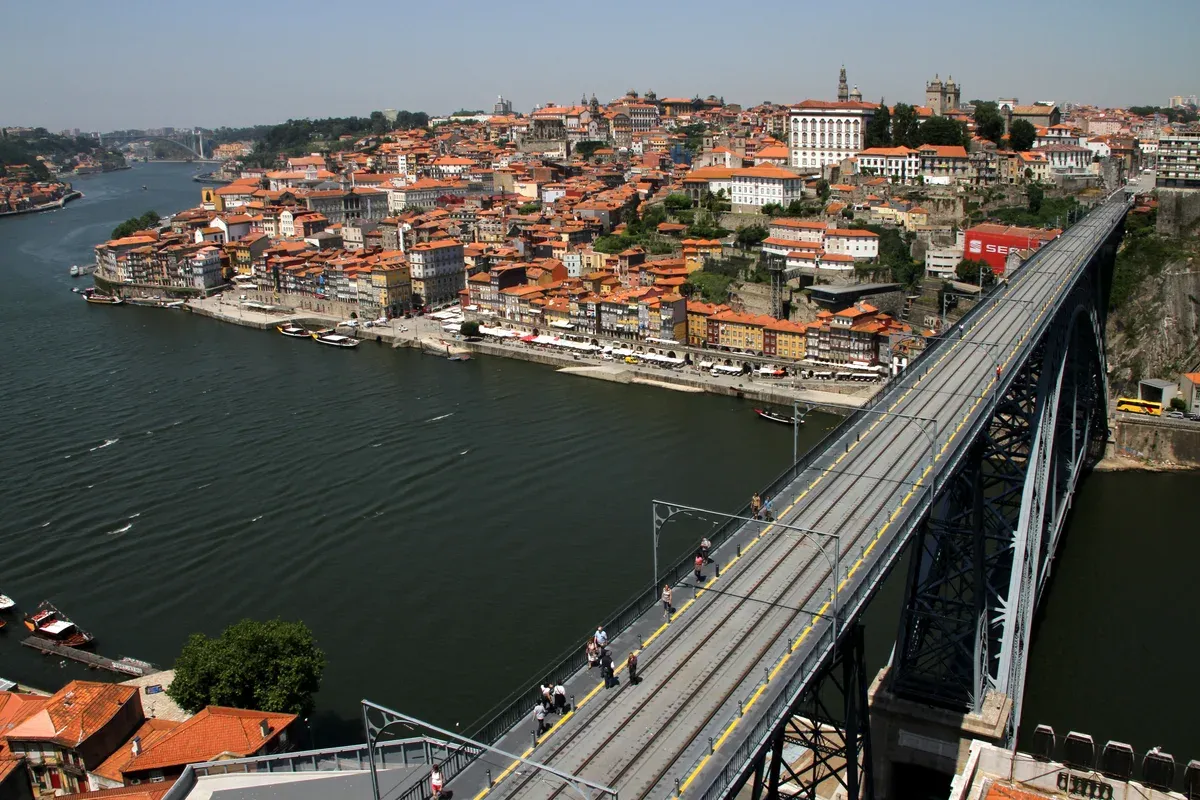
The Dom Luís I bridge crossing the Douro between Porto and Vila Nova de Gaia. Photo: Gerd Eichmann, CC BY-SA 4.0, via Wikimedia Commons
Ponte Luís I Questions
What is the most famous bridge in Porto?
The Ponte Luís I. Its 172.5 m iron arch was the longest of its type in the world when it opened in 1886, and it is part of the UNESCO site inscribed in 1996 together with the historic centre of Porto and the Monastery of Serra do Pilar. You can walk both decks for free, and the lower deck is the walking route to the Gaia lodges described in Crossing to the Port Lodges.
Why is the Dom Luís I Bridge important?
Three reasons. It was built 1881-1886 to a design by Théophile Seyrig, a partner of Gustave Eiffel, with a 172.5 m span that set a world record for its type. It carried road traffic on the upper deck until 2003, when it closed for conversion to Metro Line D. And it is a National Monument since 1982 and part of the 1996 UNESCO listing. It also remains the practical link between the Ribeira and the port lodges, so it matters for anyone planning Vila Nova de Gaia.
How tall is the Ponte Dom Luís I bridge?
The published figure for the bridge is about 70 m high, with an upper deck 395.25 m long and a lower deck 172 m long. That height is what the upper walkway gives you over the river. The full figures are in The Bridge in Numbers.
Can you walk across the Dom Luís I Bridge, and how long does it take?
Yes, on both decks, and it is free. The route is the lower deck from Ribeira to the Cais de Gaia or the upper deck to Jardim do Morro, so allow a relaxed pace. Cross on top for the view, below for the riverside lodges, or skip the climb back by taking the Teleférico de Gaia, which covers the two levels in 3 min 45 s for €7 one-way. Tours that cross with a guide include the Port Wine Lodges Walking Tour.
How do I get to the top of the Dom Luís I bridge?
Take Metro Line D, which runs on the upper deck itself, one stop from São Bento to Jardim do Morro, using a Z2 ticket, listed at €1.40, and an Andante Azul card at €0.60. Trains run about every 5-6 minutes on weekdays. You step off right at the Gaia end of the upper deck, next to the Jardim do Morro garden and the upper station of the Gaia cable car, whose round trip costs €10 if you want to ride down to the river after.