 Porto Wine Tours
Ruby vs Tawny Port
The ruby vs tawny port question is the first one every visitor to a Gaia cellar asks. The answer comes down to one word: oxygen. Ruby styles are protected from oxygen and keep their deep red fruit, while tawny styles age for years in wood and slowly turn golden and nutty. This guide sets the two families side by side, walks through every category in each one, from reserve to 40 year old tawny, and shows where to taste them in Vila Nova de Gaia. For the full range of styles, including white and rosé, see what is port wine, and for the full list of Porto wine tours on this site the homepage compares them all.
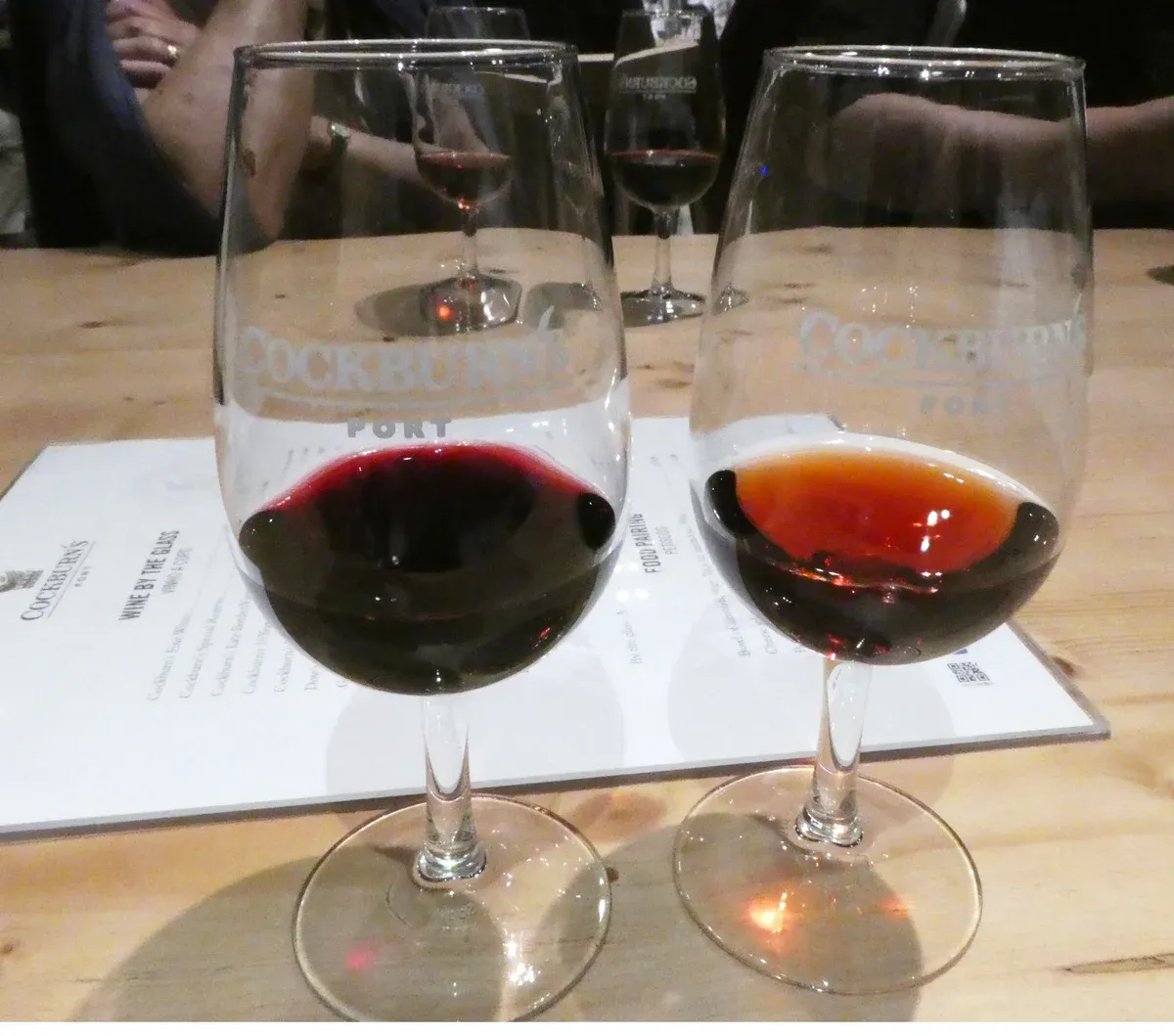
A ruby port and a tawny port poured side by side in matching glasses at a Gaia lodge tasting. Photo: Verity Cridland, CC BY 2.0, via Wikimedia Commons
Quick answer The short answer
Ruby port usually spends two to three years in large vats and keeps its deep red fruit, while tawny port ages in oak casks for years or decades, taking colour and nutty flavours from slow oxidation. IVDP puts ruby styles at 12-16 C on serving and tawny styles at 10-14 C. Neither is better. Ruby tastes of cherry, blackberry and blackcurrant, tawny of dried fruit and nuts from wood ageing. Opened ruby keeps 8-10 days, opened tawny 3-4 weeks, per IVDP.
Key takeaways
- Compare the two families row by row in the side-by-side table.
- New to port? Start with a tasting that pours both, such as the guided Gaia tasting walk with 9 tastings at 3 lodges.
- The Sandeman cellar tour pours White, Ruby and Tawny in one 50-minute visit.
- Vintage and LBV get deeper treatment in the vintage port guide, one line and a link is all they need here.
Ruby and Tawny Side by Side
Two families of the same fortified wine, separated by one choice: where the wine matures. The figures below come from the IVDP, the institute that classifies port, and from house technical sheets.
The One Table That Settles It
Everything in this table traces back to the IVDP or to the port houses themselves. Where a house disagrees with the institute, both figures appear. Port in general runs 19-22% alcohol, so the difference you taste is not strength. It is oxygen. Ruby is protected from it, tawny is exposed to it.
If you remember a single row, remember the first one. Vat ageing keeps ruby fruity and deep red. Wood ageing turns tawny amber, concentrates it and gives it the dried fruit and nut character that people mean when they say tawny port wine.
| Feature | Ruby | Tawny |
|---|---|---|
| How it ages | In large vats about 2-3 years, up to 3 years in wooden barrels per Wines of Portugal (Taylor's) | In oak casks in the lodge, exposed to air, often for 7 years to 40+ years (IVDP, houses) |
| Colour | Deep ruby red. Vintage shows intense ruby young, garnet when mature (IVDP) | Amber to golden brown, from golden red to light gold on the IVDP colour scale |
| Taste | Cherry, blackberry and blackcurrant fruit (Taylor's) | Dried fruit and nutty notes from cask ageing |
| Categories | Ruby, Ruby Reserve, LBV, Vintage, plus Crusted (IVDP) | Tawny, Tawny Reserve, 10/20/30/40 year old, Colheita (IVDP) |
| Serve at | 12-16 C (IVDP). Sandeman says around 15 C or 16-18 C | 10-14 C (IVDP). Sandeman says 12-16 C, a 30 Year Old at 14-16 C |
| Once open | Ruby and Ruby Reserve 8-10 days, LBV 4-5 days, Vintage 1-2 days (IVDP) | Tawny and Tawny Reserve 3-4 weeks, age-indicated tawny and Colheita 1-4 months (IVDP) |
Sources: IVDP, Port wine categories
The Ruby Family
Ruby style ports keep the colour and fruit of young wine because they age in vat rather than in oak casks.
Ruby and Ruby Reserve
Basic ruby is the entry point of the family. Taylor's states that ruby ports age in vat for two or three years, and Wines of Portugal puts the figure at up to 3 years in wooden barrels. The wine then goes to bottle and keeps its deep colour.
Ruby Reserve is the step up. The IVDP describes it as full-bodied, rich and deep ruby, frequently a selection of the best port made each year, and grades it 7, very good, on its own sensory scale. Reserve ports age slightly longer in vat than basic ruby, per Taylor's. Once open, IVDP gives both ruby and ruby reserve 8-10 days. Sandeman is more generous, saying ruby is best within a month of opening.
- Ages in vat 2-3 years before bottling
- Ruby Reserve graded very good (7) by IVDP
- Serve at 12-16 C per IVDP
- Keeps 8-10 days open per IVDP
LBV, the Ready-to-drink Vintage
Late Bottled Vintage is a single-year ruby aged four to six years in wood, per the IVDP, then bottled. Most LBV is ready to drink on purchase, and Taylor's says it needs no decanting, unlike a classic Vintage. That practical difference explains why LBV has become so popular. Taylor's reports that LBV is one in five port purchases in the UK, and that the first LBV was launched in 1970 as an affordable, ready-to-drink alternative to Vintage.
Some LBVs are bottle-matured and unfiltered. Wines of Portugal requires bottle-matured LBV to spend at least three years in bottle, and unfiltered examples such as Fonseca's benefit from decanting and are best within two months of opening. This page keeps LBV short because the vintage and LBV detail lives in the vintage port guide.
- Single harvest, 4-6 years in wood (IVDP)
- Ready to drink on purchase for most bottles
- Serve 16-18 C per Fonseca, 15-17 C per Quinta do Noval unfiltered
- IVDP allows 4-5 days open, Fonseca says two months for unfiltered
Vintage and Crusted
Vintage port is the category in the ruby family that ages longest in bottle. IVDP rules require it to come from a single year and be bottled two to three years after the harvest, and the wine then develops for 10 to 50 years. Houses declare Vintage only in outstanding years. Taylor's says historically only about three years are declared per decade, and it announces its decision on Saint George's Day, 23 April, after two winters in oak vats.
Crusted port is the family's curiosity. The IVDP describes it as a blend of intense, full-bodied wines kept in bottle at least three years before sale, which throws a deposit called the crust. Taylor's adds that it is not from a single vintage and is not filtered before bottling. Wines of Portugal puts crusted at 3-4 years in wood before bottling, and IVDP grades it 8, high, the same tier as LBV and Colheita. For declared years and decanting detail, read the vintage port guide.
Tawny vs Ruby Port Wines, Compared and Tasted
The two families poured side by side, with what the colour and taste tell you. Third-party video by No Sediment. This site did not shoot it and has no relationship with the creator.
The Tawny Family
Tawny port wine is made in the lodge, not the bottle. Long cask ageing, with the wine in partial contact with air, gives every tawny its amber colour and nutty, dried-fruit flavour.
Tawny and Tawny Reserve
Basic tawny is the lightest expression of the family, and the reserve is the first real step into wood-driven flavour. The IVDP lists Tawny Reserve among its special categories and says simply that it is aged in oak. Wines of Portugal puts the average age of a reserve tawny at five to seven years, which is the only official-style figure available for the tier. IVDP grades reserve tawny 7, very good, the same tier as reserve ruby.
Serving follows the tawny rule of 10-14 C per IVDP, though Sandeman suggests 12-16 C for its own tawnies. Opened bottles are forgiving. IVDP gives tawny and tawny reserve 3-4 weeks, which makes an opened reserve a far less urgent bottle than a ruby. That resilience comes from the same oxidation that made the wine, since the cask ageing has already done most of what air can do.
What 10, 20, 30 and 40 Years Actually Mean
The age indications are the heart of tawny port wine, and the commonest misunderstanding about them is easy to fix. A 20 Year Old tawny is not one wine kept in a cask for exactly 20 years. The IVDP allows indications of 10, 20, 30 and 40+ years, and Sandeman explains that these blends combine several harvests, with the stated age the approximate average age of the wines in the blend. Cálem uses the same wording: a 10 Year Old is a blend aged an average of 10 years in oak casks.
The houses show what the averages look like in practice. Sandeman's 30 Year Old is a strict selection of wines between 25 and 40 years of age, at 20% alcohol. Graham's 40 Year Old is aged an average of 40 years in seasoned oak casks. Quinta do Noval ages its 40 Year Old in 640-litre casks called cascos. IVDP grades all age-indicated tawnies 8, high, on its sensory scale. Taylor's sells the style in all four ages and its Century Collection gift box holds one of each, 100 years of combined ageing.
Older tawnies are also generous once opened. IVDP allows 1-4 months, Graham's suggests 8 weeks for its 40 Year Old, Sandeman 2-3 months for its 30 Year Old, and Quinta do Noval 3 months. Serve them slightly chilled, at 10-14 C per IVDP, with no decanting, since these wines are filtered.
| Indication | What it means | Opened bottle keeps |
|---|---|---|
| 10 years | Blend averaging 10 years in oak casks (Cálem, Sandeman) | 1-4 months (IVDP) |
| 20 years | Blend averaging 20 years, several harvests combined (Sandeman) | 1-4 months (IVDP) |
| 30 years | Sandeman blends wines aged 25-40 years for its 30 Year Old | 2-3 months (Sandeman) |
| 40 years | Blend averaging 40 years, aged in seasoned oak or 640-litre cascos (Graham's, Noval) | 8 weeks to 3 months (Graham's, Noval) |
Colheita, the Single-year Tawny
Colheita answers an obvious question: what if you want tawny character from one named harvest? The IVDP defines Colheita as single-vintage tawny aged in cask for a minimum of seven years. Dow's notes that colheitas are aged like blended tawnies in seasoned oak casks but represent one single year, and Burmester confirms the wood period never falls below 7 years.
Some houses go far beyond the minimum. Quinta do Noval's 2012 Colheita was first bottled after about 15 years in wood and served at 9-14 C. Cálem states as house policy that all its colheitas age at least 10 years, a stricter figure than the IVDP floor, so both numbers are true depending on the bottle. Burmester advises serving its 1998 Colheita at 14-16 C and drinking it within 2-4 months of opening, stored upright away from light, which matches the IVDP window of 1-4 months for the category.
On IVDP's sensory scale, Colheita is graded 8, high, level with age-indicated tawnies and LBV. If you like the idea of a vintage-dated bottle but want something ready to drink tonight rather than a wine to lay down, a colheita is the tawny answer to that problem.
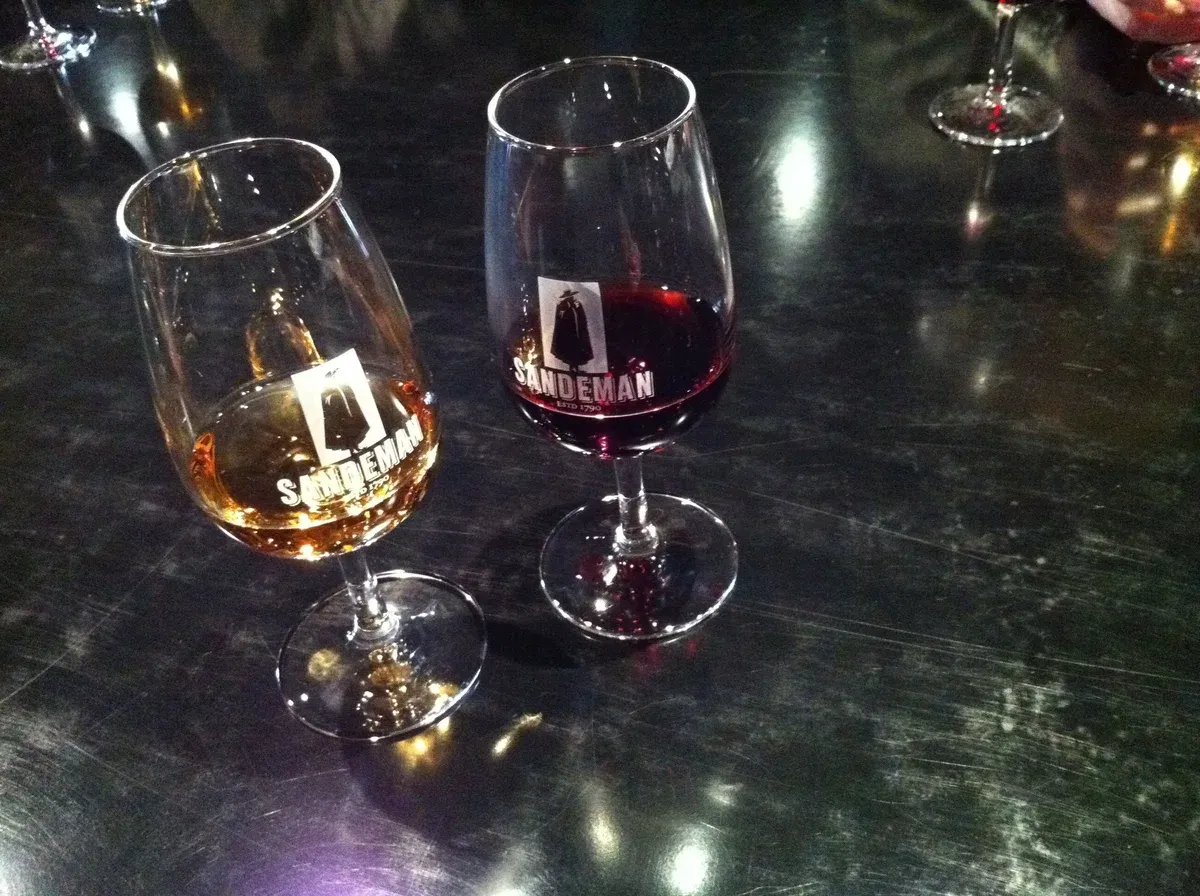
Two Sandeman glasses of port, one amber and one deep red, poured at a tasting after a lodge tour. Photo: elvum, CC BY 2.0, via Wikimedia Commons
Which to Taste First in Porto
Order matters more on your first day than on your fifth. Tannin and fruit fade against old wood, so a ruby before a tawny keeps both wines readable.
The Classic Three-glass Flight
A classic flight runs white, ruby, tawny. That order works, because it moves from the lightest and coldest style to the two red-grape families, with the ruby's fresh fruit ahead of the tawny's wood notes. The Sandeman cellar tour is the cleanest example on this site, a 50-minute guided visit to cellars where port has aged since 1811, then exactly White, Ruby and Tawny, for $26. If you want a first taste of the ruby vs tawny port difference in one sitting, that ticket does it.
At Poças the family flight tilts ruby-ward. The Poças guided visit shows a century-old aging cellar and pours white, LBV and Reserve Tawny in the tasting room, 3 ports for $26 over 1.5 hours. It is a simple way to put an LBV, a ruby-family wine aged 4-6 years in wood, next to a wood-aged tawny and taste the oxygen difference for yourself.
Nine Pours Across Three Lodges
For a wider sweep of both families in one afternoon, the small-group Port and Douro wine tour visits 3 different wine lodges in Vila Nova de Gaia with 9 tastings of port and DOC Douro wines over 3 hours, for $56.12, meeting on the Avenida Diogo Leite riverfront. The nine tastings include DOC Douro wines as well as port, so not every pour is a ruby or a tawny.
The multi-lodge walk by Porto Walkers starts on the Porto side of the river. The port wine lodges walking tour covers 3 port houses with 7 tastings and entry tickets included over about 4 hours, for $64.14, ending with a lesson in how to taste port professionally. The Porto Walkers listing names lunch, food and snacks as not included. For a single-lodge option, the Cálem cellar tour pairs a 15-minute interactive museum with a 30-minute cellar visit and a tasting from $25, and Cálem's own tawny page is where the house defines its 10 to 40 year old blends.
When to Spend on Aged Tawny
Basic flights do not always reach the old tawnies, so read the pours listed on each ticket. Graham's sells its lodge visit in tiers, with a premium guided tasting in the 1890 lodge at $45 for 2 hours, offered as Premium with pairings or Port Essentials. The Premium option lists Graham's LBV, Quinta dos Malvedos and a 20 Year Old Tawny. Real Companhia Velha runs the lowest starting price on this site, a guided cellar tour with selected port tastings from $22, including access to the Silva Reis private cellar of 16,000 bottles, though the exact pours depend on the option booked.
A practical rule: try a basic ruby and tawny first, then spend your upgrade money on the tawny side. Check what each ticket pours before you pay for an upgrade.
Ruby and Tawny Questions
Is tawny or ruby port better?
Neither is better, they are different ageing philosophies. Ruby is bottled young, usually after 2-3 years in vat, and tastes of cherry, blackberry and blackcurrant. Tawny spends years in oak and tastes of dried fruit and nuts. IVDP grades LBV, Crusted, Colheita and age-indicated tawnies at the same level, 8 or high, and Vintage one step above at 9. See the side-by-side table.
Which is sweeter, port or tawny port?
Sweetness is set when fermentation is stopped, not by colour, so a ruby and a tawny can carry the same sugar. IVDP grades port sweetness by grams per litre, from extra dry under 40 g/l to very sweet over 130 g/l. The winemaker sets the sweetness per what is port wine.
What does the 20 years on a tawny port bottle mean?
It is an average, not a deadline the wine met. IVDP allows indications of 10, 20, 30 and 40+ years, and Sandeman explains that the blend combines several harvests with the stated age the approximate average age of the wines in it. Cálem words it the same way for its 10 Year Old: a blend aged an average of 10 years in oak casks. The age table has all four indications.
How long does port last once opened?
Tawny lasts much longer than ruby, because the oxidation that made it has already happened. IVDP allows 8-10 days for ruby and ruby reserve, 4-5 days for LBV, 1-2 days for vintage, but 3-4 weeks for tawny and reserve tawny and 1-4 months for age-indicated tawny and Colheita. Sandeman is more generous with ruby, saying within a month. The families guide lists each one.
At what temperature do you serve ruby and tawny port?
IVDP says ruby style at 12-16 C and tawny style at 10-14 C, so tawny is served slightly cooler. Houses differ a little: Sandeman gives ruby around 15 C or 16-18 C, its tawnies 12-16 C, and a 30 Year Old 14-16 C. None of these figures call for a fridge overnight, just a slightly cooled bottle. Details sit in the serving rows.
Which port should I taste first in a Porto cellar?
Start with a flight that pours white, ruby and tawny in that order, so fresh fruit comes before wood-driven notes. The Sandeman cellar tour does exactly that in 50 minutes for $26, and the Poças visit adds an LBV to a reserve tawny for the same $26. Save aged tawnies for a premium tier visit such as Graham's premium tasting at $45.